Écriture
England, December 2025
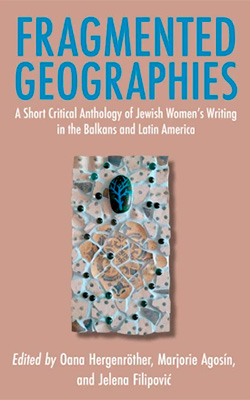
Fragmented Geographies: A Short Critical Anthology
of Jewish Women’s Writing in the Balkans and Latin America
Edited by Oana Hergenröther, Marjorie Agosín, and Jelena Filipović
Love, Loss, and Life between the Biobío and the Danubio This anthology embraces a physical stretch of land, sea, mountain, marsh, desert, and woods that lies between the two rivers, the Biobío originating in the Chilean Andes and flowing into the Pacific at Concepción, Chile, and the Danube flowing through central and eastern Europe. This space is not measured in miles but in the spiritual and creative journeys of Jewish women writers from Latin America and the Balkans. Spanning novels, memoirs, and poetry, their diverse voices create a unique literary landscape where two seemingly distant regions find common ground in shared histories of refuge, marginality, and sanctuary.
This critical collection brings together powerful stories of
resilience following immense trauma – from the survival of death
camps and oppressive regimes to the realities of exile. The authors
explore what it means to reinvent themselves dynamically and
constantly with life in a new land, a new profession, and often,
a new language.
Back Cover
This collection includes the following writers: Marjorie Agosín, Ruth Behar, Mimoza Erebara, Jelena Filipović, Rita Gabbai-Simantov, Michal Held Delaroza, Oana Hergenröther, Andrea Jeftanovic, Ava Kadishson Schieber, Entela Kasi, Gordana Kuić, Luljeta Lleshanaku, Myriam Moscona, Angelina Muñiz Huberman, Rosa Nissàn, and Michèle Sarde.
From “In Search Of Marie J.” [À la recherche de
Marie J.] By Michèle Sarde
Translated from the French by Domnica Radulescu
“Thus, like modern alchemists, we sailed on our ship in search of
gold, the gold of a mesh of hair, the gold of a necklace, the gold
of a wedding band left intact in the embers.
We traveled in search of Marie and Moise, of their childhood, of
their hopes, of their loves. In search of their joys and sorrows
in the past world that they inhabited. In search of their future,
of their survivors, of certain genes that they scattered on this
planet and that allowed them to persist.
I call the Antigone syndrome the force that drives and pushes me
today to pursue Marie and Moise, to enable them to resurrect, and
to build their grave. A work of memory in the shape of mourning
and resiliency. But mostly a work of bringing into the world the
Lost Ones.”